



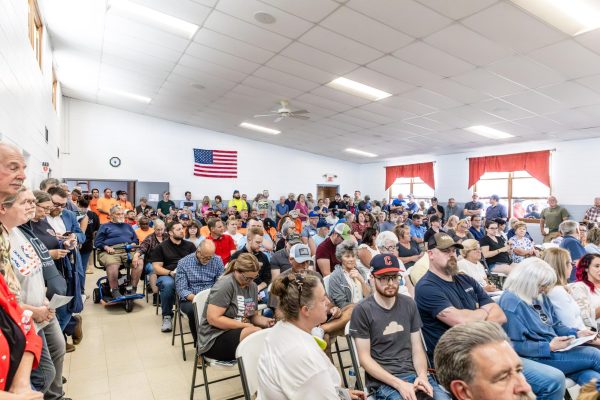
Shalersville residents and surrounding community members packed the town hall on Tuesday to learn and voice concerns over a proposed 750-megawatt data center to be built by Geis and Bitdeer Technologies.
Bitdeer is a Singapore-based trading company that specializes in bitcoin mining and AI cloud storage. The company has already built data centers in Tennessee, Washington and Massillon, Ohio.
Bitdeer’s largest facility is a 600-megawatt center in Texas, and now they are proposing to build an even larger facility just under 12 miles from Kent State University.
Shalersville Township currently has a moratorium against data centers in place until November, which cannot be renewed.
Residents listened to a presentation by Bitdeer and Geis representatives about the data center, as well as information from township trustees and District 72 state representative Heidi Workman.
Due to the large turnout, some had to stand outside and listen through windows because the town hall reached maximum capacity. People could also sign a petition to ban the construction of mass data centers in Ohio and buy yard signs protesting the center.
Workman reviewed what she has done at the state level as a part of the Joint Data Center Committee, addressing the issue of data centers with the introduction of House Bill 646. The bill, which has not passed into law yet, aims to regulate large-scale data centers.
“You have to understand that there are many jurisdictions across the state of Ohio that are welcoming these developments. So, not all are rejecting them,” Workman said. “We had to be very careful about how we were gonna balance that demand, because some communities see it as a massive investment. Others want to say, ‘no data centers in my community.’”
In their presentation, Bitdeer representatives went over the construction phases of the project and addressed multiple concerns about noise, light and water pollution. Community members and township trustees had the opportunity afterward to ask questions.
Those in attendance voiced their concerns and dissent against the proposed data center. Concerns ranged from the center’s effect on water and electrical supply, noise and land pollution, decreasing home values and the impact on local wildlife
According to the presentation, the data center will be built on 257 acres and will be composed of 15 data halls and plus office space.
Bitdeer will employ 150 to 200 jobs, in addition to around 400 construction jobs. The company hopes to employ local workers, citing that 45 workers at their Massillon facility live within 5 miles of the data center.
There will be no tax abatements for the center.
“So what makes this different is from the very beginning, we never asked for tax abatements for any of our projects,” said Paul Hanson, Bitdeer’s senior project manager.
Since data centers have existed for many years before the emergence of large-scale operations, Shalersville has had zoning rules in place. Bitdeer would have to follow township zoning for lighting, utilities, landscaping, noise, equipment and building footprint.
“The township has already adopted zoning rules and regulations with respect to conditional zoning certificates for a data center use,” said Lenny Asaro, an attorney from Taft, Stettinius and Hollister Law Firm, hired by Bitdeer.
Bitdeer would also be required to comply with noise tolerances, which have raised many concerns within Shalersville and surrounding communities.
The building of the project will be divided into two phases, according to Brandon Kline, Geis’ vice president of design. The first phase will begin south of Beck Road.

The two tech centers built during this phase will be around 53,000 square feet and 30 feet tall, and include 50,000 square feet of office space. A sound wall will be put into place to keep noise away from surrounding properties and an electric substation will be put in as well.
“The intention there is to keep the noise of mitigation away from the neighboring properties and push the sound back into the facility,” said Kline.
Phase two involves the remaining property north of Beck Road, with the construction of 12 data halls that are 53,000 square feet and 30 feet high. The buildings will be inward-facing to help with noise mitigation. After hearing concerns from residents, another sound wall will be installed around the majority of the northern portion of the project.
Conditional use conditions state that noise levels are to be below 50 decibels at property lines. Bitdeer will be using equipment louder than the 50-decibel rating, but aims to lower that noise at property lines to around 43 to 48 decibels using sound walls and sound enclosures.
According to Soluna Computing, another Bitcoin and AI company, a data center usually produces a humming noise ranging from 55 to 85 decibels. Consistent noise levels up to 85 decibels are comparable to heavy construction sites.
Beyond noise, water usage is a major concern for residents.
According to Kevin Noble, an engineer at Scheeser Buckley Mayfield Engineering, a closed-loop system will be used to cool down the computer chips using propylene glycol, a food-safe chemical.
Once filled with propylene glycol brought from a manufacturer, no additional water needs to be added to cool the chips.
“You buy a premixed solution that’s brought in from a manufacturer that’s already made that mix, put in the system, and once that system’s in, it’s closed loop,” Noble said.
The facility does require 3,000 gallons of water per day for human consumption due to the office complex, as required by building codes and the EPA.
“The facility will use water. It’ll be a closed-loop system to cool the chips themselves, but the facility itself will have to provide water for the employees that they have there.” Noble said.
The infrastructure operation and updates for the data center will be paid for by Bitdeer, according to Tony Clark, an electrical engineer from Great Oaks Engineering. The data center would operate on its own substation, and would not raise residents’ electricity bills.
“Will it raise residents’ electric bills? No. A resident’s electric bill is set by the state, the PUCO, and PJM. We are not part of that,” Clark said.
The proposed data center would also generate nearly 2.17 million dollars in tax revenue. This would result in a 115% increase for Shalersville Township and 35% for Crestwood Local Schools.
The meeting became heated at times when Bitdeer representative took questions. Some residents asked the company to build elsewhere, and others flat-out said they did not want a data center in their community.
One resident asked the room to raise their hand if they are against the data center.
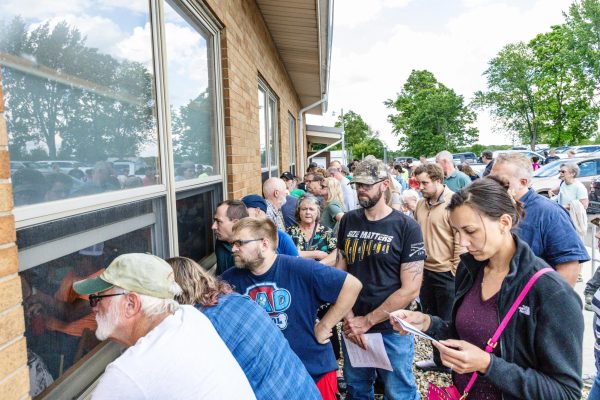
Nearly every hand went up.
George Jyurovat lives in Shalersville and has property lines that match those for the data center. He believes the data center would change the way of life for Shalersville residents.
“We live here because we like a quiet town. A lot of people live here and move here for the exact reason,” he said. “We are farmers and country people and hard-working people that want to go home and have a quiet night, and that changes our way of life.”
Shalersville resident Holly Etling attended the meeting due to concerns about the data center’s environmental impacts.
“I am concerned that the data center’s expansion across the United States is just pillaging through our natural resources,” Etling said. “At what cost is what I keep asking myself; is it worth it?”
Jessica Winchell, the leader of the Portage Residents for Responsible Development, came to the meeting to ask questions about the purpose of the facility but was disappointed by responses provided by Geis and Bitdeer.
“Unfortunately, it does not feel like they truly have the local community’s best interests in mind,” Winchell said. “I think what really summed it up was when people asked, ‘Why do you want to be in a community that doesn’t want you?’ And they were unable to answer.”
Loreal Puleo is a staff writer. Contact her at [email protected].
