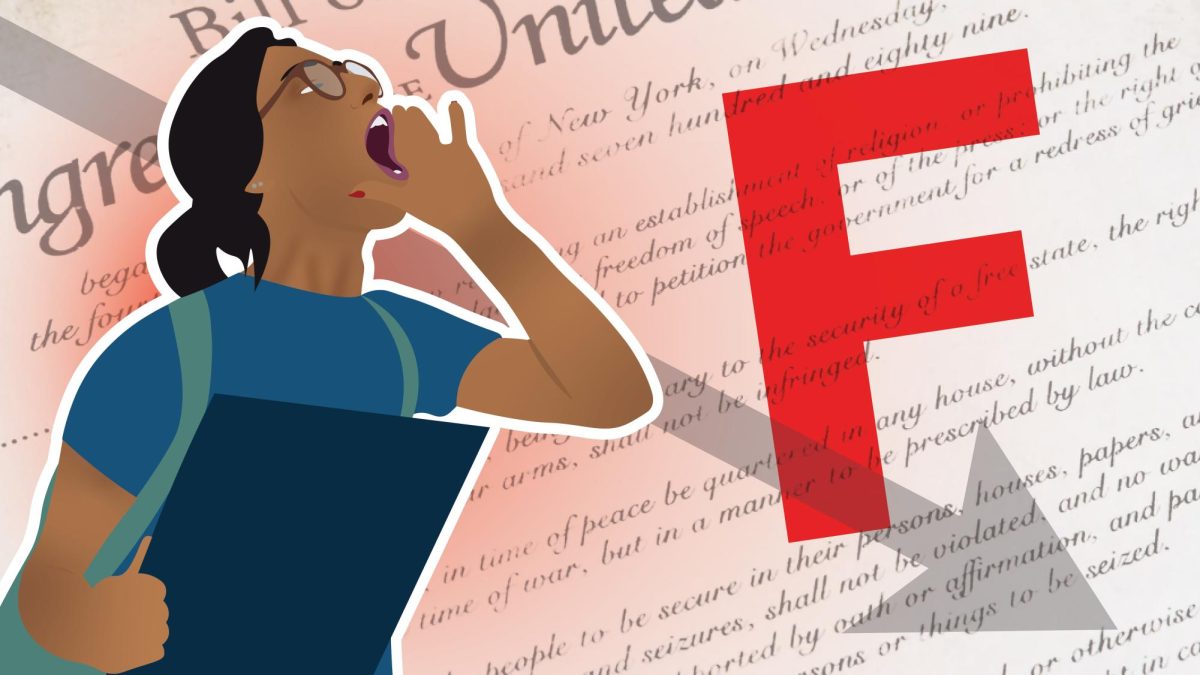
Kent State University scored an “F” on The Foundation for Individual Rights and Expression’s 2026 College Free Speech Rankings.
FIRE was originally founded as the Foundation for Individual Rights and Education, focusing on defending free speech rights of students and faculty on college campuses in the U.S. Sean Stevens, chief research advisor, said the organization expanded its mission in the last few years to protect the expressive rights of all Americans.
“Free speech, academic freedom, they’re not just these abstract ideals that we should honor,” Stevens said. “They’re really essential to both the production and advancement of human knowledge.”
FIRE’s College Free Speech Rankings combines three main aspects of research to finalize the rankings: student experiences, speech controversies and university policies.
First, FIRE looks at student experiences through a survey. The survey goes out in the spring semester of the preceding year. The 2026 rankings come from information from the spring semester of 2025, and the information is released at the start of the next semester. This year, 257 colleges and over 68,000 students were surveyed.
Stevens said the survey consists of 21 questions assessing students’ comfort speaking up about controversial topics, how often they self-censor, topics they find difficult to discuss, political tolerance, thoughts on their administration and current events.
Next, FIRE tracks the outcome of speech controversies on campus. This can include campus de-platforming, primarily related to speakers having their talks canceled, but it can also include art exhibits, movie screenings, plays, etc. Students and scholars under fire, related to attempts to sanction faculty and students or student groups for expression, are also considered.
Lastly, FIRE’s Policy Reform team rates speech policies that schools have for students. A green rating means there are no policies that threaten students’ free speech, yellow means one or more policies could be applied to certain speech but not others and red means policies clearly threaten speech and expressive rights and could be deemed as unconstitutional. A school can also receive a warning rating, which happens if the team feels a school is not prioritizing the First Amendment and placing other values above it.
Kent State received an overall score of 54.5/100 and a rank of 196/257 schools, moving down more than 150 places from last year. It also received a yellow light ranking, indicating several policies still restrict speech.
The main change came from the removal of a student art exhibit depicting political violence last spring. Kent State remains in the top 50 for administrative support, in the bottom 50 for self-censorship and in the bottom quartile for comfort this year.
To improve the rating, Stevens said FIRE encourages schools to adopt The Chicago Principles, created in 2014 at the University of Chicago, which declares that schools guarantee the freedom of expression. It has since been adopted by over 110 other universities.
Schools can also adopt an official position of institutional neutrality, meaning schools can comment on current issues without taking a stance on them.
Free speech is how we learn and produce knowledge, Stevens said, and there’s value in interrogating even a bad idea, to analyze and reinforce why it’s bad. Theoretical breakthroughs, social reform and cultural shifts come from those willing to challenge the status quo.
“If we are squashing that, I think we’re going to stunt our progress, and maybe even, not make any or not produce new knowledge and not change things that need to be changed,” Stevens said.
Savana Capp is a hard beat reporter. Contact her at [email protected].
Kayci Balog is a reporter for KSTV. Contact her at [email protected].
