


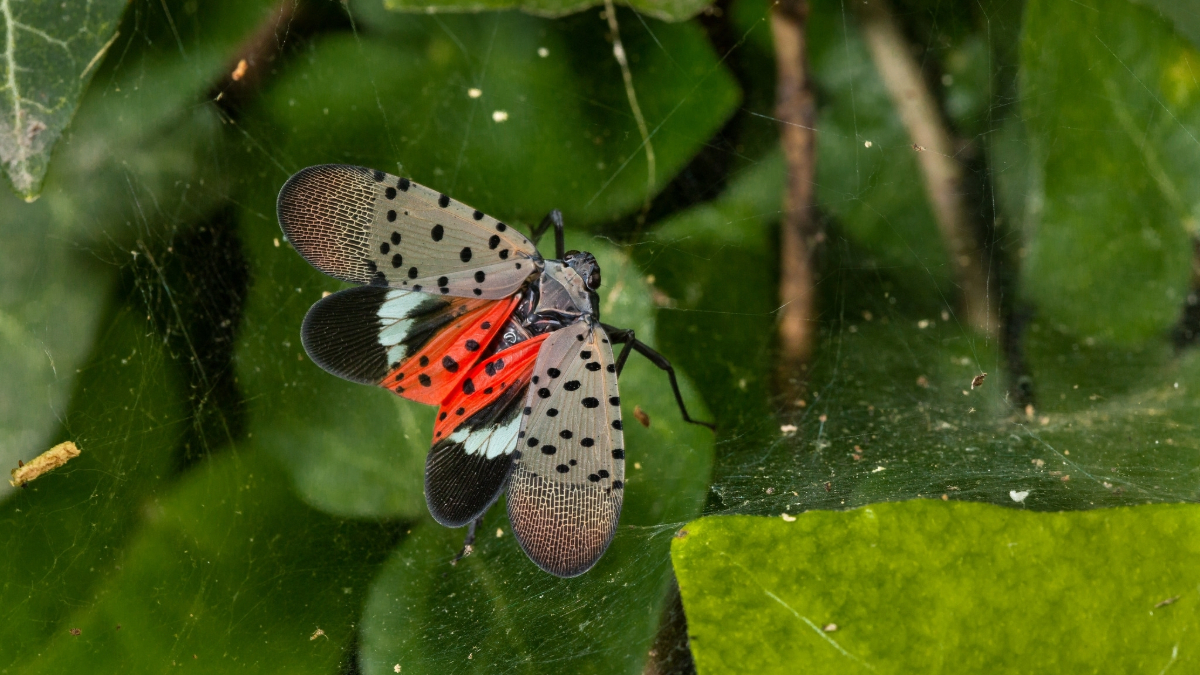
The spotted lanternfly has soft pinkish-brown wings with black dots spanning into a pattern that resembles the desert floor.
When in flight or when startled, a scarlet streak is visible on its rear wings.
If you spot one of these beautiful plant hoppers, you should kill it immediately. Stomp, smash and destroy it.
The Ohio Department of Agriculture designated the spotted lanternfly as an invasive and “destructive plant pest.” These insects have an insatiable hunger for plant sap, as they can only survive for around 48 hours without feeding.
Spotted lanternflies gather en masse to feed, and once they start, they excrete a sticky, vinegary-scented waste called honeydew.
The buildup of honeydew can promote the growth of black sooty mold and attract other nuisance insects like yellowjackets, said Bekkah Berryhill, manager of the Kent State grounds department.
Together, spotted lanternflies feeding on a plant can weaken it by causing oozing sap, wilting, leaf curling and dieback.
The spotted lanternfly’s primary plant host is the tree-of-heaven, which is another invasive species.
The tree-of-heaven is super prolific and aggressive, Berryhill said. Allowing plants like that to colonize can “put our native landscape at risk because they’ll kind of darken out the resources for our native plants.”
Berryhill’s predecessor got rid of most of the trees-of-heaven on campus, but there are still a few around. One is on the east side of the Liquid Crystal and the Material Sciences building.
The grounds team has seen significant numbers of spotted lanternflies on these trees.
“It’s kind of creepy. It looks like the bark is actually moving,” Berryhill said.
Some people hoped the spotted lanternflies would kill off their preferred host, but that hasn’t been the case.
“It’s just given us kind of like a one-two punch…with we still have a lot of tree-of-heaven, and now we have a spotted lanternfly problem,” Berryhill said.
However, the spotted lanternflies aren’t just sticking to the tree-of-heaven. Around the Kent area, people have seen small groupings of them on native silver maple trees.
All a tree needs is a small nick for the spotted lanternflies to latch on for a meal, which worries Berryhill.
Native trees of the area, like maples, birches and black walnuts, have little to no protection against the spotted lanternflies.
There are no native predators in the area that prey on these insects. Birds like cardinals and bluejays will sometimes eat them but prefer them if they’ve had the sweeter sap of a native tree compared to the foul-tasting sap of a tree-of-heaven, Berryhill said.
To slow the spread of these pests, the ODA has put 17 counties, including Portage County, under quarantine since October 2021.
Spotted lanternflies are hitchhikers. They travel to new places on any outdoor hard surface, including trailers, trucks and firewood. If you can move it, they can come along for the ride. According to the ODA, you should check your vehicle and belongings when going in and out of a quarantined county and remove host plants.
This means the grounds team can’t move things to and from non-quarantined zones, including products from plant nurseries.
They also need to be intentional and thorough with their own materials.
For example, if they decide to turn a fallen tree into mulch, they need to make sure they grind the wood to the point where spotted lanternfly egg masses would surely be killed.
Back in September, adult spotted lanternflies started laying eggs in sheltered areas of trees, buildings and other outdoor surfaces.
Egg masses, which contain up to 60 eggs, vary in color from white to a brownish gray and have a protective waxy covering. As winter progresses, they resemble dried, cracked mud.
No different than the adults; if you see egg masses, you should destroy them. The ODA recommends scraping them off into soapy water or rubbing alcohol.
But make sure to use something gentle like plastic, not metal, Berryhill said. “We don’t want people to necessarily take a knife and scrape them off because that could probably almost do more damage to the trees than anything.”
The well-hidden egg masses that don’t get scraped will hatch into little black nymph lanternflies with white polka dots, who will eventually grow into their scarlet stripe.
The nymphs look like real-life Pokémon with their awkward shape and bright color, Berryhill said.
She hopes the spotted lanternfly wave will pass Ohio and continue to move southwest, but expects more to come in 2026.
It’s important for people on the ground to share information with her so she can have a better idea of the spotted lanternfly presence on campus, she said.
For example, Berryhill learned about a ton of spotted lanternflies on the roof of Williams Hall from an unexpected call from a KSU PD officer doing a routine check.
Berryhill can be contacted by phone at 330-672-5615 or through email at [email protected].
Bianca Amoako is a reporter. Contact her at [email protected].
