


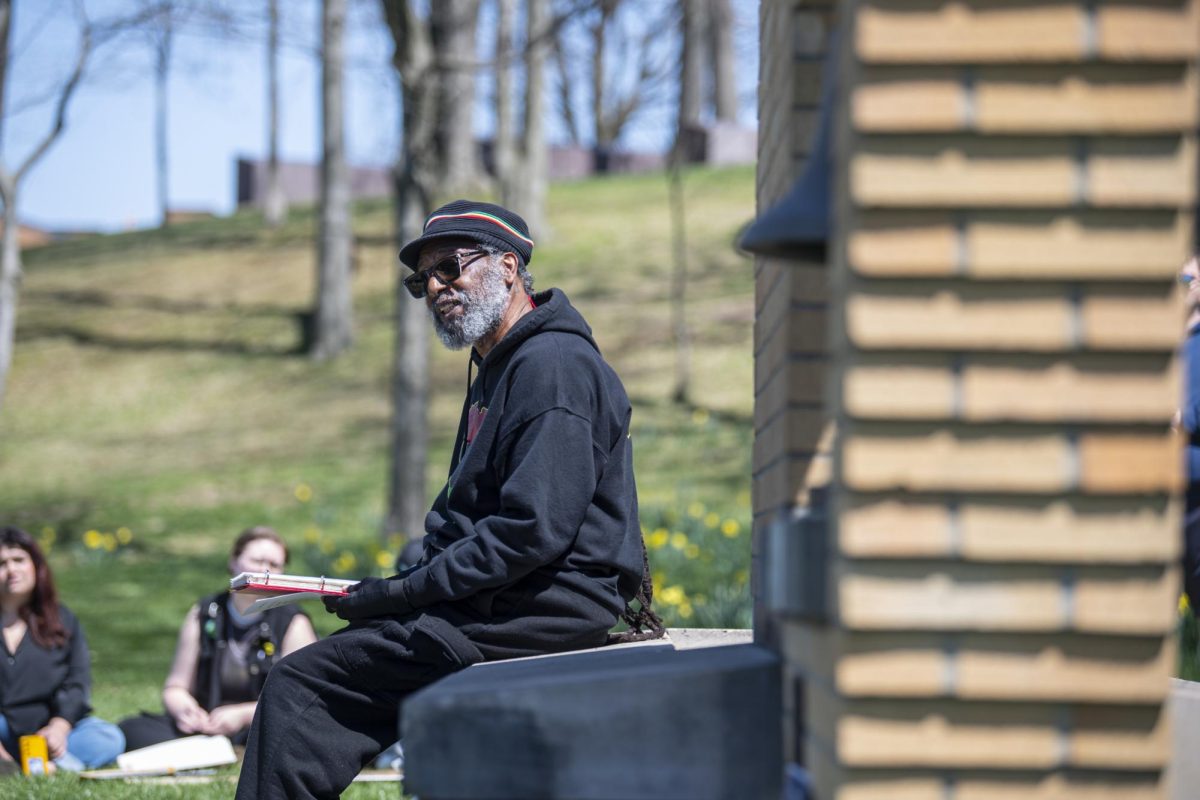
When Mwatabu Okantah arrived at Kent State University in September 1970, he was an 18-year-old freshman from New Jersey, walking onto a campus that had reopened just months after the National Guard killed four students. The young man was trying to find out his identity – and he figured that out here.
By 1975, Okantah had changed his name from Wilbur Thomas Smith Jr. to “Mwatabu,” meaning “born in a time of tribulation” in Swahili, “Okantah,” meaning “breaker of rock” in the Ga language of Ghana. By now, he has been Mwatabu Okantah far longer than he was Wilbur Smith Jr.
“I’m a born-again African,” Okantah said. “It was a spiritual, cultural awakening.”
He earned his bachelor’s degree from Kent State in 1976 and began teaching in the Africana Studies department that same fall as a graduate assistant.
At 73 years old, Okantah will officially retire on June 1 as professor and chair of the Department of Africana Studies – he has been teaching for 50 years.

Okantah’s path to chairmanship is not a typical faculty story. He did not arrive at Kent State as a scholar. He arrived as a student activist. Shortly after enrolling, he was recruited into Black United Students, the student organization whose 1968 walkout had forced the university to negotiate the creation of a Black Studies program, a Black cultural center and the hiring of more Black faculty and staff.
“I was groomed by upperclassmen who had participated in the 1968 walkout,” he said, “I was mesmerized and in absolute awe of the militant group spirit they exuded.”
He was swept up into something already in motion, and he rode that wave throughout his whole career.
After earning a master’s degree in creative writing from the City College of New York in 1982 and teaching at institutions such as Rutgers University and Cleveland State University, he returned to Kent State as a faculty member in 1991.
He rose to professor, then chair. The student who once demanded the department became the man running it.
Felix Kumah-Abiwu, associate professor and founding director of the Center for African Studies at Kent State, has worked alongside Okantah for 11 years.
“His ideas and values helped the department to experience growth after he came back in the 1990s as a faculty member,” Kumah-Abiwu said. “That’s a remarkable achievement and an inspiring story about his professional journey.”
Students have long called Okantah “Baba” – a Yoruba word for father or respected elder. It is not a nickname that he gave himself, but one that was earned over decades.
In both the classroom and outside the classroom, he gave his students what it means to study and know their “history, culture, identity and self-worth,” Kumah-Abiwu said.
Okantah taught “The Black Experience” for years – most of his students were white.

“Students were taking the Black Experience courses because they felt that there were aspects of the American story that had not been shared with them,” he said.
He taught three generations of one family – a grandmother, a mother and a grandchild. He has former students whose children have now sat in his classroom.
“I truly believe that a teacher is only as good as our students allow us to teach them,” Okantah said. “And so I’ve been very blessed in that regard.”
But some of his most powerful moments with students happened far outside of northeast Ohio.
As director of the Ghana Study Abroad Program since 2016, Okantah took students and community members to ancestral lands on the African continent.
He and Kumah-Abiwu led one such trip together in 2017. Okantah said watching students respond to what they were seeing and feeling there, was among the highest points of his entire career.
“On those trips,” Okantah said, “I want to do for those people what the people who took me to Africa for the first time did for me.”
In 2019, he took a group of students to Ghana during the government’s “Year of the Return” – a celebration marking 400 years since the first Africans arrived in what became the United States. He described the experience as extraordinary.
“There were people from the diaspora – from Belize, Canada, the UK, Jamaica, Cuba, Brazil,” he said. “And there we were all together, sharing our stories, and literally embracing our diversity. It was extremely powerful.”
But at 73, even the most devoted teacher reaches a point where they have to turn the page to the next chapter.
Okantah is clear as to why this is happening now. He is 73. He has dreams he has not yet chased. There are things he and his wife have wanted to do now that their children are grown.

He is still a poet, percussionist and performer. He is completing a prose work called “The View from Stono,” which draws on his travels through the American South and the 1739 Stono Rebellion in South Carolina.
Retirement, he said, is not an ending. It is a different kind of beginning.
Okantah embraces the identity of a griot – a West African oral historian and keeper of communal memory.
“For me, you don’t retire from that,” he said, “You just continue to do that.”
Still, the backdrop against which he is leaving is impossible to ignore.
Ohio Senate Bill 1, signed into law in March 2025 and effective June 2025, banned DEI programs at public universities, prohibited faculty strikes and introduced oversight of classroom instruction.
Kent State closed three identity-based support centers and eliminated 19 undergraduate degree programs, one of them being the Bachelor of Arts in Africana Studies. Applications to the degree stopped being accepted this spring.
Due to SB1 policies, the department Okantah spent his career building will no longer offer the degree that defined it.
“The university presidents, the administrators, the board of trustees people — they all caved,” he said. “They all caved because it’s a form of extortion. You either do what we say, or we’re going to deny you your funds. And I’m a reconstructed activist from the ’70s. I would have dared them. They all should have said no.”
He is direct about what he believes it will take to reverse course.
“The only way to get it back is: one, at the polls,” he said. “Two: it’s going to require that students organize themselves to demand what they want as part of their education.”
This is, notably, the same thing BUS did in 1968.
Okantah has been teaching since 1976, and he retires on June 1. Whatever comes next, he made one thing clear.
“I could be a problem for the university,” he said, “because I’m not going to shut up.”
Brendan Walsh is a reporter. Contact him at [email protected].
Karen Melcher • May 4, 2026 at 3:32 pm
Went to Union HS with him, remember him well! Congrats on your retirement and a life well led