


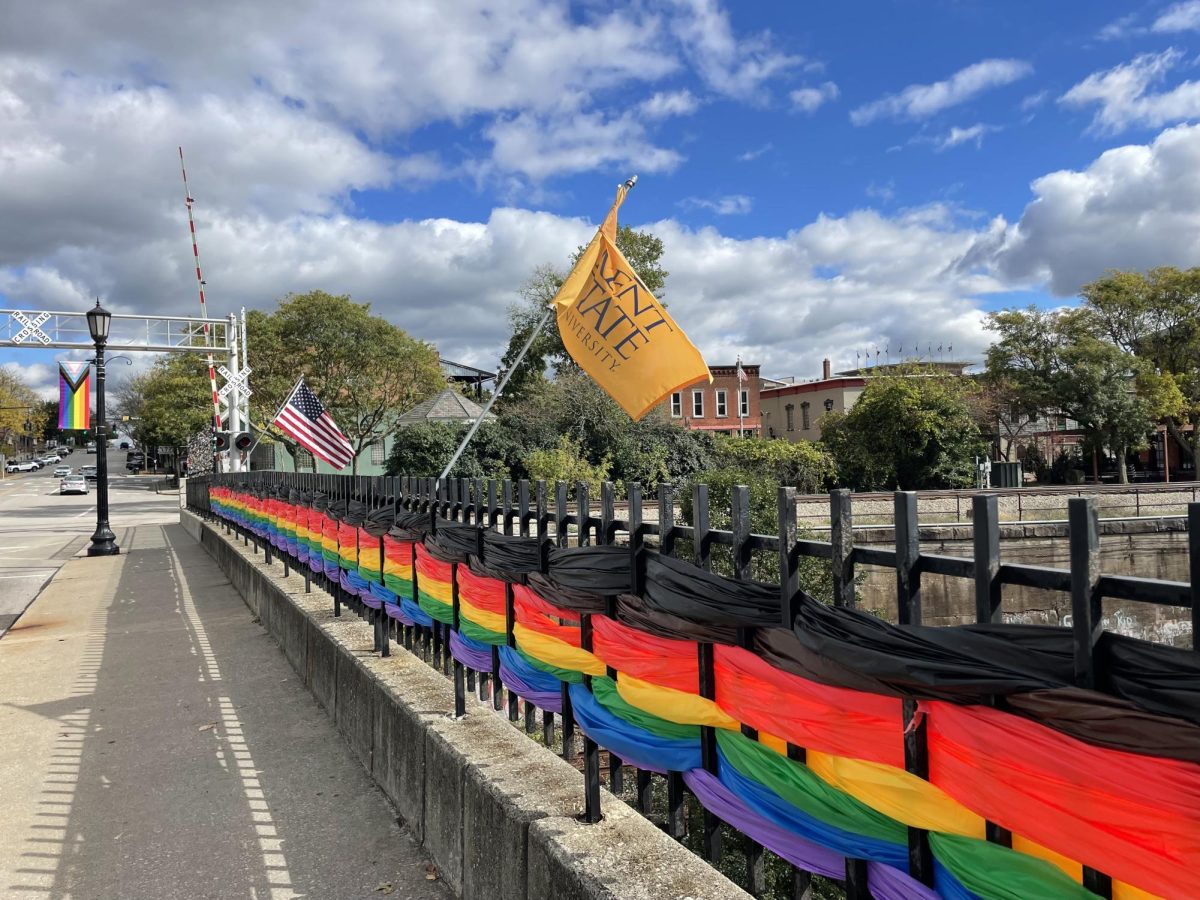
For multiple consecutive years, Kent State University was rated a 5/5 on the Campus Pride Index. It is home to a flourishing community of LGBTQ+ students, but despite the support for them, many say they still face discrimination for their sexuality or gender identity.
Freshman communication studies major Noah Ryan, who identifies as queer, said he sees the prejudice regularly.
“I’ve had quite a few students involved within the Christian and Republican communities openly express their disgust with homosexuals once they get to know me,” Ryan said. “I’m very straight-passing, so people come up to me and say the wildest things. One student let me know he switched roommates because he could not abide with living with a gay man.”
Despite this, the same student invited Ryan to a church service. Out of respect, as well as curiosity, he decided to attend.
“I have never been stared at by that many eyes in my life,” Ryan said. “I went there and it’s like they could clock me immediately.”
Raised religious, Ryan now considers himself to be a spiritual person, but finds it difficult to find a place for people like him inside of religious groups on campus.
“It’s a lot of people tied together and there’s some shared love there, but there’s a lot of shared hate,” he said. “You can feel it right away.”
Micro-aggressions like these are committed against LGBTQ+ people frequently, according to Kent State LGBTQ+ Studies advisor Lauren Vachon.
“Because I teach so many LGBTQ students in my classrooms, I hear from almost every single one of them that at some point on this campus, something has happened,” Vachon said. “Slurs shouted, jokes being told in front of them. … A group of people walking past Korb Hall saying, ‘That’s the gay dorm’ and laughing.”
Garrett Wrentmore, a sophomore mechanical engineering major who identifies as gay, said he regularly deals with situations like these.
Last year, Wrentmore was walking to his friend’s dorm when he passed a group of men making comments about queer people.
“I don’t remember exactly what the men said, but they made a comment about how many queer people were on campus. When I was passing by, the men glared at me and said, ‘There’s one right now,’” he said. “Maybe they didn’t mean to be offensive, but I sincerely doubt that considering they laughed after.”
Based on KSU’s 2025 Engagement and Well-Being Survey, higher percentages of queer students, asexual students and bisexual students experience more sexual and gender-based harassment on campus compared with heterosexual students who participated in the survey.
However, micro-aggressions and nonviolent forms of harassment are not where the prejudice stops.
Wrentmore said he was targeted by one of his high school classmates because of his sexual orientation.
“Sophomore year, I went on a walk with my sister and friends,” Wrentmore said. “We passed a classmate of ours and his friends. Unprompted, he started yelling slurs and tried to throw rocks towards our direction.”
Sexual orientation-based hate crimes made up 17.2% of all hate crimes in 2024, according to the FBI’s latest annual crime report, totaling 1,950 recorded incidents. The FBI’s Crime Data Explorer shows this is a lower figure than the 2,366 incidents reported in 2023.
The report also showed 3.9% of hate crimes stemmed from a gender-identity bias in 2024, totaling 527 incidents against transgender or gender-nonconforming individuals.
KSU’s Engagement and Well-Being Survey also shows that bisexual and queer-spectrum students experience stalking at a higher rate than heterosexual students. Bisexual students also experience dating or intimate partner violence at a higher rate than heterosexual students.
The queer community on Kent State’s campus used to have a place to turn to when dealing with experiences like these: The LGBTQ+ Center, which offered counseling services and an emergency fund for those in need.
Prior to the passage of Ohio Senate Bill 1, centers like the Women’s Center, Student Multicultural Center and the LGBTQ+ Center used to report to Yvonna Washington-Greer, associate vice president for Belonging Engagement and Success for the Division of Student Life.
SB1 prompted KSU to shut down the centers in June 2025. Without a place dedicated to advocating for queer students on campus, several KSU students said they are worried about what the university can still do for them.
Washington-Greer spoke about what KSU can still give to its students in terms of support even after the closing of these centers.
“What I can tell you is that what we’re allowed to do is support all students, which is something that we have been able to,” Washington-Greer said. “We’ve been hosting trainings for all student organizations to make sure that they understand what is available for them across campus.”
She said despite the closure of the LGBTQ+ Center, the emergency funding for students did not disappear but now falls under a different umbrella.
“We’re telling students to go to our CARES center because the emergency funding is still available through that source,” she said. “It does not say ’emergency funding for LGBTQ+ students’, it says ‘emergency funding.’ … Tell them what your needs are and they will go through their process to make sure that you’re eligible. … The same way it would have happened if the LGBTQ+ Center was there.”
Washington-Greer said even without the centers, the on-campus resources the LGBTQ+ Center would have referred students to are still operating and anyone is welcome to utilize their services.
She and the other faculty members for the Division of Student Life are dedicated to making sure that students have access to this information.
“I just want students to know that the people we are at this institution involves the same folks, meaning even though we had to close those centers because of the state bill, Kent State still values each and every one of their students,” she said.
Washington-Greer’s goal is simple: Let every student know that they are valued.
Syd Yanok is a reporter. Contact her at [email protected].
